

STEM Resources
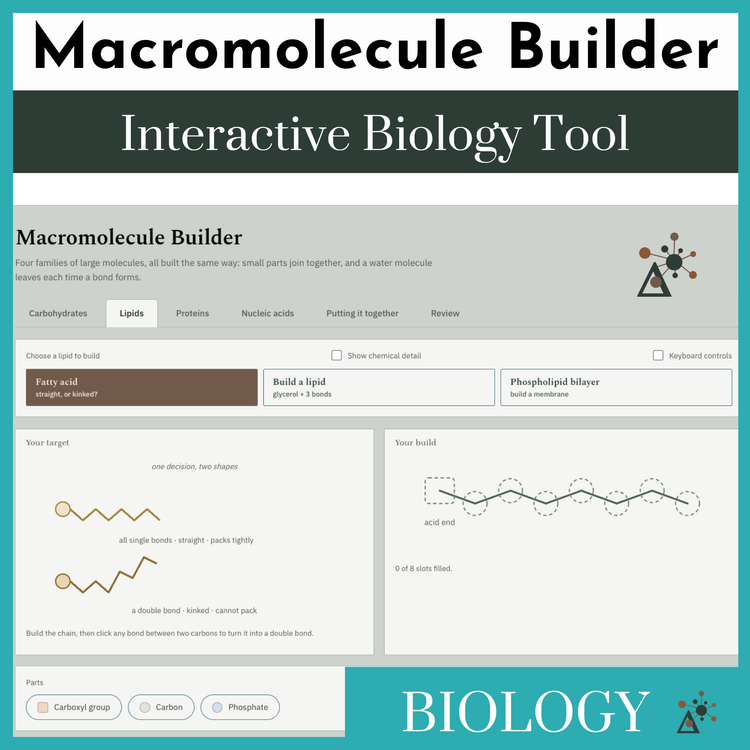
Macromolecule Builder
Build carbohydrates, lipids, proteins, and nucleic acids piece by piece, and watch a water molecule leave every time a bond forms.
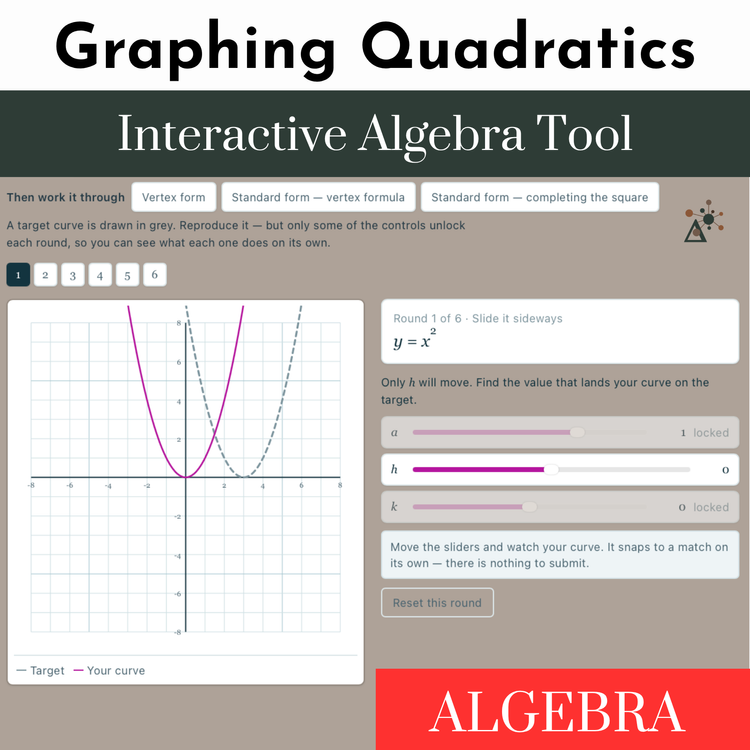
Graphing Quadratics
Work through a parabola one decision at a time — find the vertex, set the direction, build a table, and watch the curve appear.
All resources A–Z
Every resource in the library, grouped by subject. Member resources link to the free library; paid resources link to the shop.
Biology (19)
- Are Viruses Alive? $2.00
- Cell Cycle and Checkpoints Graphic Organizer Free for members
- Cell Cycle Vocabulary Organizer Free for members
- Cell Cycle: Deep Dive Into Interphase (Video Lesson) Free video
- Cellular Division: Cell Cycle Guided Notes $4.00
- Errors in Meiosis Lesson and Guided Notes $2.00
- Henrietta Lacks and HeLa CER Free for members
- Introduction To Biology Notes and Presentation $3.00
- Macromolecule Builder Free, no sign-up
- Macromolecule Builder Worksheet & Answer Key Free for members
- Meiosis I and II Cut and Paste Sequencing Activity $2.00
- Meiosis Lesson Presentation and Guided Notes $3.00
- Mitosis Presentation and Guided Notes $3.00
- Mitosis Sequencing Cut-and-Paste Activity $2.00
- Mitosis vs. Meiosis Activity $2.00
- Nondisjunction and Trisomy 13 — Meiosis Error CER Activity $2.50
- Spontaneous Generation $2.00
- The Cell Cycle Checkpoints Lesson Presentation and Notes $4.00
- The p53 Gene - Read and Annotate Activity $2.00
Chemistry (8)
- Conversions and Dimensional Analysis Practice Free for members
- Counting Significant Figures Worksheet Free for members
- History of the Atomic Model Graphic Organizer | Atomic Theory Notes Free for members
- History of the Atomic Model Graphic Organizer | Cut and Paste Activity $2.00
- SI Unit & Dimensional Analysis: Video Lesson Free video
- Significant Figures Reference Sheet Free for members
- Significant Figures: Video Lesson Free video
- Units of Measurement Conversion Chart Free for members
Math (18)
- 12 x 12 Multiplication Table Free for members
- Adding and Subtracting Integers: Practice Problems Free for members
- Converting Decimals and Fractions Worksheets Free for members
- Divisibility Rules Reference Free for members
- Fractions & Decimals Free for members
- Fractions and Decimals Revision Problem Set 2 Free for members
- Graphing Quadratics Tool Free, no sign-up
- Fractions and Decimals Revision: Video Lesson Free video
- Graphing Quadratics: Guided Notes and Problem Set! $3.00
- Introduction to Relations and Functions: Guided Notes and Practice Problems! $3.00
- Modeling Using Quadratics Worksheets $2.00
- Solving Quadratic Equations by Factoring $2.00
- The Coordinate (Cartesian) Plane Free for members
- The Number Line & Absolute Value Revision: Video Lesson Free video
- Types of Real Numbers Guided Notes Free for members
- Types of Real Numbers Problem Set 1 Free for members
- Types of Real Numbers Problem Set 2 Free for members
- Types of Real Numbers: Video Lesson Free video

Delta Learning Space builds standards-aligned biology, chemistry, and math resources for high school classrooms and for the students working through the material at home. Everything here was written by a working tutor and classroom substitute, then used with real students before it was published.
Filter by subject, format, or audience to find what fits your unit. Video lessons and the Macromolecule Builder are open to anyone. Printable downloads live in the free member library, which takes about a minute to join. Paid resources are priced so a single teacher can buy one out of pocket without filing a purchase order.
Biology resources
The biology collection is built around two units taught in nearly every high school course: the nature of science and cell division. The introductory materials cover the characteristics of life, the scientific method, scientific data types, and spontaneous generation as a case study in how scientific ideas get overturned. The macromolecules material covers carbohydrates, lipids, proteins, and nucleic acids, with the interactive Builder as a hands-on companion.
The cell division unit runs deep: interphase and the cell cycle, the G1, G2, and M checkpoints, mitosis and meiosis with cut-and-paste sequencing activities, and errors in meiosis including nondisjunction and Trisomy 13. Several resources use claim-evidence-reasoning structure rather than recall questions, including the p53 tumor suppressor activity, the Henrietta Lacks and HeLa cells reading, and an argumentation piece asking whether viruses meet the criteria for life. Lesson presentations come paired with guided notes so you are not building slides from scratch.
Chemistry resources
The chemistry collection covers the measurement and math skills that determine whether students can handle the rest of the course. Significant figures get a full treatment: a one-page rules reference students can keep in a binder, a practice worksheet covering counting, rounding, and operations, and a video lesson for students who need to hear it again.
Unit conversions and dimensional analysis follow the same pattern, with an SI units and measurement conversion chart alongside practice problems and a video walkthrough. The atomic theory materials trace the history of the atomic model from Dalton forward as a cut-and-paste graphic organizer, which works well as a first-week activity or as review before a bonding unit.
Math resources
The math collection spans upper elementary review through Algebra 1. The number properties strand covers factors and prime factors, multiples and least common multiples, divisibility rules, properties of operations, and adding, subtracting, multiplying, and dividing positive and negative integers. Fractions, decimals, and place value get guided notes plus two problem sets at different difficulty levels, which is useful when a class needs the same skill at two speeds.
Moving up, there are materials on the types of real numbers and rational versus irrational operations, the coordinate plane, relations and functions, evaluating functions, and finding domain and range. The quadratics strand covers graphing in vertex form and standard form, factoring, solving by factoring, and modeling word problems, which is usually where students hit the wall in Algebra 1. Reference sheets, including a 12 x 12 multiplication table and a divisibility rules chart, are there for students who need the scaffold.
What is in the free member library
The member library holds every free printable download in one place: guided notes, practice problem sets, graphic organizers, CER activities, and reference sheets across all three subjects. Creating an account is free and always will be. The library exists so that resources stay findable and so downloads do not scatter across a dozen blog posts.
Two things sit outside the library entirely. Video lessons are on YouTube and need no account. The Macromolecule Builder runs in the browser with no sign-up, no download, and nothing recorded or stored, so it works on a Chromebook cart or projected for a whole class.
Questions teachers ask
Are these resources standards-aligned?
The science resources are written against NGSS performance expectations, with an emphasis on the science and engineering practices rather than vocabulary recall. The math resources follow the Common Core progression for grades 5 through Algebra 1. Individual product listings name the specific standards where relevant.
What grade levels are these for?
The biology and chemistry resources are written for high school, generally grades 9 through 12, and several work in an on-level or honors section without modification. The math resources range wider. Fractions, decimals, and integer operations suit grades 5 through 7 or serve as review in a high school support class. Functions and quadratics are Algebra 1 material.
Can I use these with my whole class?
Yes. Resources are licensed for use with your own students. Printing class sets and posting to a password-protected platform such as Google Classroom or Canvas is fine. Sharing files with other teachers, uploading them to a public site, or distributing them across a department requires an additional license. If you need a department or site license, email and we will sort it out.
What is the difference between free and paid resources?
Free resources tend to be single-purpose: a reference sheet, a graphic organizer, one practice set. Paid resources are usually full lessons with presentations, guided notes, answer keys, rubrics, and extension activities. The free materials are not samples or teasers. Plenty of teachers use only the free library, and that is a legitimate way to use this site.
Can I use these for homeschool or independent study?
Yes, and many families do. The guided notes and problem sets with answer keys work well without a teacher present, and the video lessons cover the same material for students who learn better from watching than from reading. Look for the Students audience filter to find resources that stand on their own.
Do you take requests?
Yes. Requests shape a good portion of what gets built, especially when several teachers ask for the same topic. Email with the unit and grade level you are stuck on.
Who makes these?
Delta Learning Space is run by Lindsey Gatlin, who tutors biology, chemistry, physics, and math from algebra through calculus. Background is a BS in Marine Science and General Biology from CSU Monterey Bay, five years in the GIS lab at California Department of Fish and Wildlife, substitute teaching in California, and three years teaching test prep in Spain. Every resource here has been used with an actual student before it went up for sale.
Working through one of these units with a student who needs more than a worksheet? One-on-one tutoring is available in biology, chemistry, physics, and math, including Digital SAT prep.