When you look at a grain of sand, it's hard to imagine anything smaller. But that grain can be cut in half, and that half can be divided again and again. Eventually, you would reach the tiny building blocks that all matter is made of: atoms. An atom is the smallest unit of an element that still has the properties of that element. Sand, for example, is mostly made of silicon and oxygen atoms bonded together. It took centuries for scientists to understand that atoms exist, and scientists today are still learning more about them.
If you want to learn more about the scientists and experiments behind some of the biggest discoveries about the atom, check out our post History of the Atom.
In this post, we will focus on the three main subatomic particles, how to find information about these particles on the periodic table, and an introduction to isotopes.
What does an atom look like?
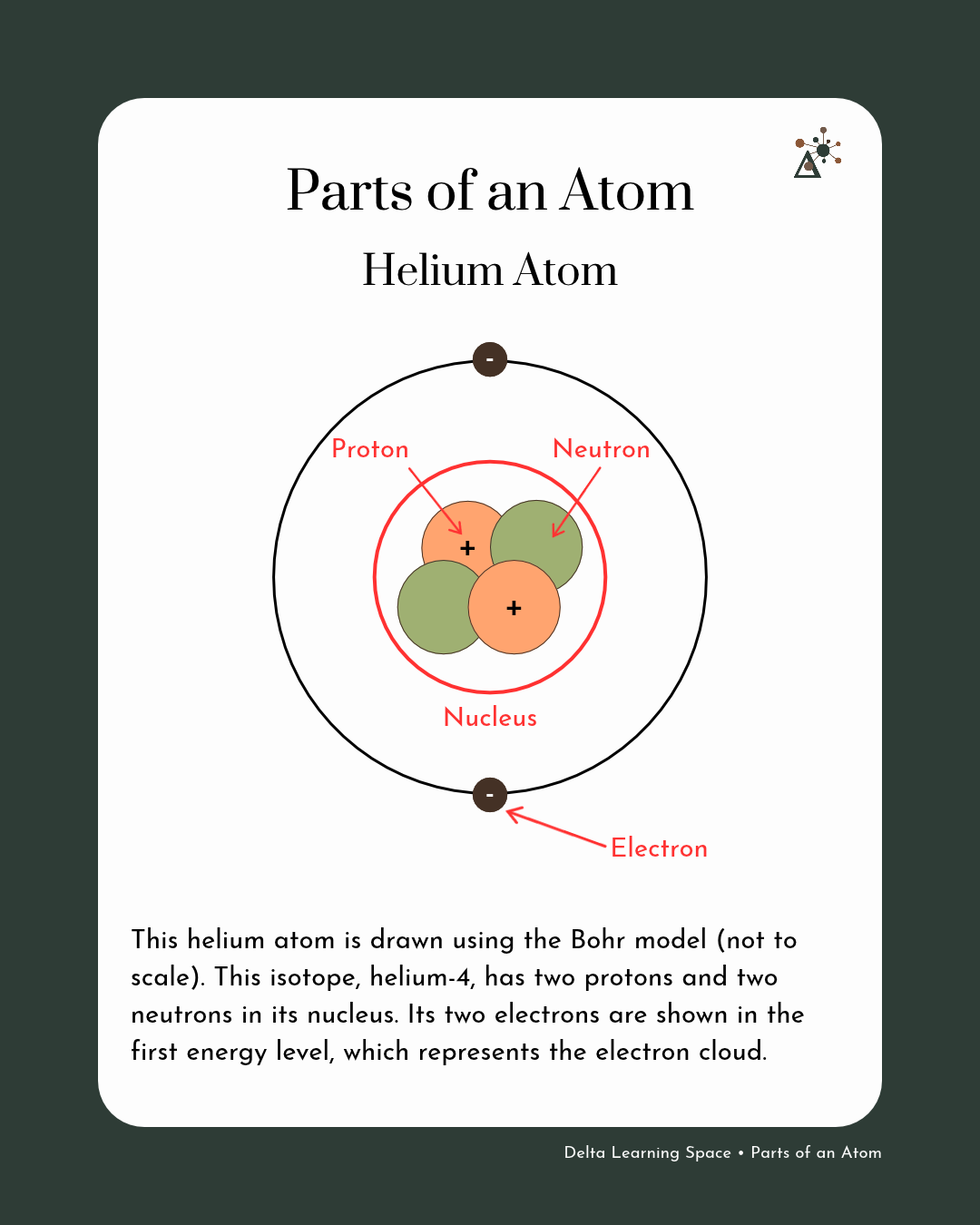
This image uses the Bohr model to show what an atom looks like. While the Bohr model is outdated, it can help us understand the subatomic particles that make up an atom. The two main regions of an atom are the nucleus and the electron cloud, and the three main subatomic particles are protons, neutrons, and electrons. Protons and neutrons are found in the nucleus, while electrons are found in the electron cloud that surrounds the nucleus. In the Bohr model, electrons travel in neat circular paths, but in reality, electrons don't follow fixed orbits. Instead, they are found in a cloud-like region around the nucleus. It is also important to note that most of an atom is empty space.
Now let's take a deep dive into each subatomic particle.
Protons
The proton was discovered by Ernest Rutherford, who published his findings in 1919. Protons are the positively charged particles found in the nucleus of the atom. The number of protons determines which element an atom is, and it is shown on the periodic table as the atomic number. For example, oxygen has an atomic number of 8, meaning that every oxygen atom has 8 protons.
Neutrons
The neutron was discovered by James Chadwick in 1932. Unlike protons, neutrons have no charge; we can think of them as neutral. Neutrons are located in the nucleus along with protons. Neutrons and protons are similar in mass, and together they make up almost all of an atom's mass. The total number of protons and neutrons in an atom is called the mass number.
Number of protons + Number of neutrons = Mass Number
Not every atom of the same element has the same number of neutrons, and an atom will not always have the same number of neutrons as protons. The number of neutrons in an atom determines which isotope it is and affects how stable the atom is. Isotopes are atoms of the same element that have different numbers of neutrons.
Electrons
The electron was discovered by J.J. Thomson in 1897, and Robert Millikan measured its charge with his oil drop experiment in 1909. Electrons are negatively charged and are found outside the nucleus, in the electron cloud. Since protons are positively charged and electrons are negatively charged, their charges cancel each other out when an atom has the same number of each, making the atom neutral overall. For example, a neutral oxygen atom has 8 protons and 8 electrons. When an atom has an unequal number of protons and electrons, it becomes an ion, which is an atom with an overall positive or negative charge.
Electrons are much less massive than protons and neutrons. An electron has only about 1/1836 the mass of a proton, so its mass is often considered negligible. Imagine a person stepping on a scale with a few quarters in their pocket. The quarters do have mass, but compared to the person, they barely change the number on the scale. In an oxygen atom, the electrons make up only roughly 0.03% of the atom's total mass.
Even though they have very little mass, electrons are important because they determine how atoms bond to other atoms.
| Particle | Charge | Mass (amu) | Location |
|---|---|---|---|
| Proton | +1 | ≈ 1 (1.007) | Nucleus |
| Neutron | 0 | ≈ 1 (1.009) | Nucleus |
| Electron | −1 | ≈ 0 (0.00055, about 1/1836 of a proton) | Electron cloud |
amu = atomic mass unit
How to identify the number of subatomic particles
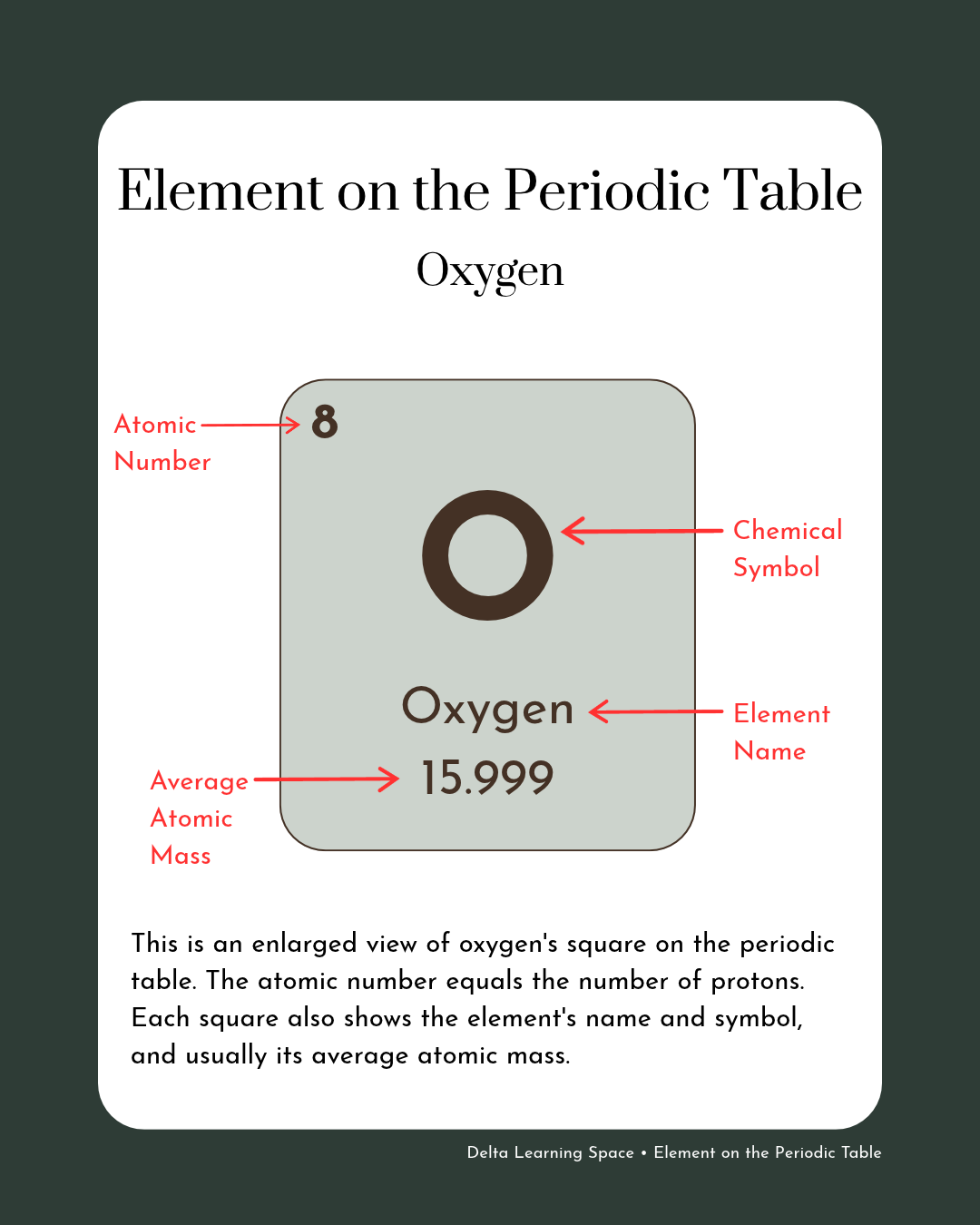
We can use the periodic table to identify the number of each subatomic particle in an atom of each element. The atomic number tells us how many protons an element has. This number never changes for a given element; a different number of protons means a different element.
If an atom is neutral, the number of protons will equal the number of electrons. The periodic table always shows neutral atoms, but when you see an element written in a problem, a charge after the chemical symbol (like O²⁻) tells you that it is an ion and has a different number of electrons.
Lastly, we can use the atomic mass, usually found at the bottom of each element's square, to estimate how many neutrons an element has. This number is the average atomic mass: a weighted average of the masses of an element's naturally occurring isotopes, based on how common each isotope is. Because it is an average, rounding the atomic mass gives us an estimate of the number of neutrons in the element's most common isotope.
For example, oxygen's atomic mass is 15.999. To find the number of neutrons, we can round the atomic mass to 16 and subtract the number of protons in oxygen.
16 − 8 = 8 neutrons
Keep in mind that this shortcut doesn't work for every element. Bromine's atomic mass is 79.90, which rounds to 80, but bromine's naturally occurring isotopes are bromine-79 and bromine-81. There is no stable bromine-80! If a specific isotope is given, we can find the exact number of neutrons without rounding.
Isotopes
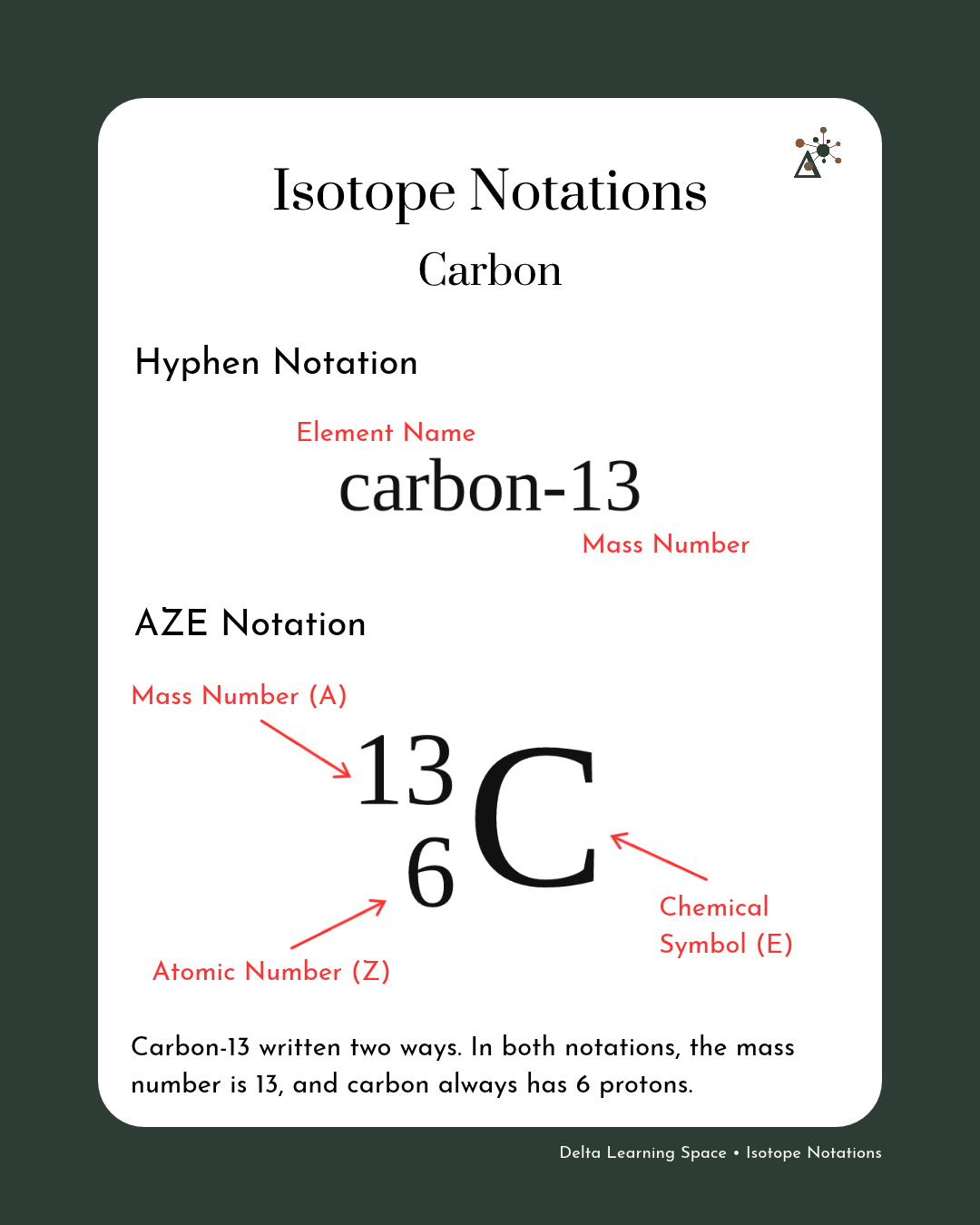
There are a few ways to write isotopes. One way is hyphen notation:
Carbon-13
In hyphen notation, the element name is written first, followed by a hyphen and the mass number. To find the number of neutrons, subtract the number of protons from the mass number.
13 (mass number) − 6 (number of protons) = 7 neutrons
Another way is nuclear symbol (AZE) notation.
In this notation, the mass number (A) is shown in the top left, the atomic number (Z) is shown in the bottom left, and the chemical symbol is written in the center. If the atom has a charge, it is shown in the top right, following the chemical symbol.
Real-World Applications of Isotopes
Isotopes help us understand the world around us in many ways. For example, marine scientists use isotope analysis, especially of carbon and nitrogen isotopes, as a cornerstone method for tracing the flow of energy through marine food webs.
Additionally, not every isotope is stable. Of the first 82 elements on the periodic table, 80 have at least one stable isotope. The two exceptions are technetium (43) and promethium (61). Every element after lead (82) has only radioactive, or unstable, isotopes. As unstable nuclei change, they give off radiation, such as alpha particles, beta particles, or gamma rays. This process is called radioactive decay, and it can turn an atom into a different element, sometimes through several steps, until it reaches a stable form. Radioactive isotopes are useful in many ways, including medical imaging. For example, technetium-99m is used in many diagnostic scans, and fluorine-18 is used in PET scans.
Conclusion
Scientists have come a long way in understanding atoms and the subatomic particles that make them up. In this post, we explored the three fundamental subatomic particles, learned how to identify the number of each using the periodic table, and introduced isotopes and some of their real-world applications. In our upcoming posts, we will learn how to find the average atomic mass, take a deep dive into reading the periodic table, explore periodic table trends, and take a closer look at ions.