SI Units and Conversions
Whenever a measurement is taken, a measurement system must be used. If you live in the United States, it is common to measure length in inches or feet. The units of inches and feet are part of the Imperial System of Measurement.
In many scientific disciplines, such as chemistry and physics, the system of measurement used is the SI system, which comes from the French Système international d’unités.
In this post, we will explore:
The SI base units
How SI prefixes are used
Conversions between SI units
Conversions between SI units and their imperial counterparts
How to correctly set up and solve conversion problems using dimensional analysis
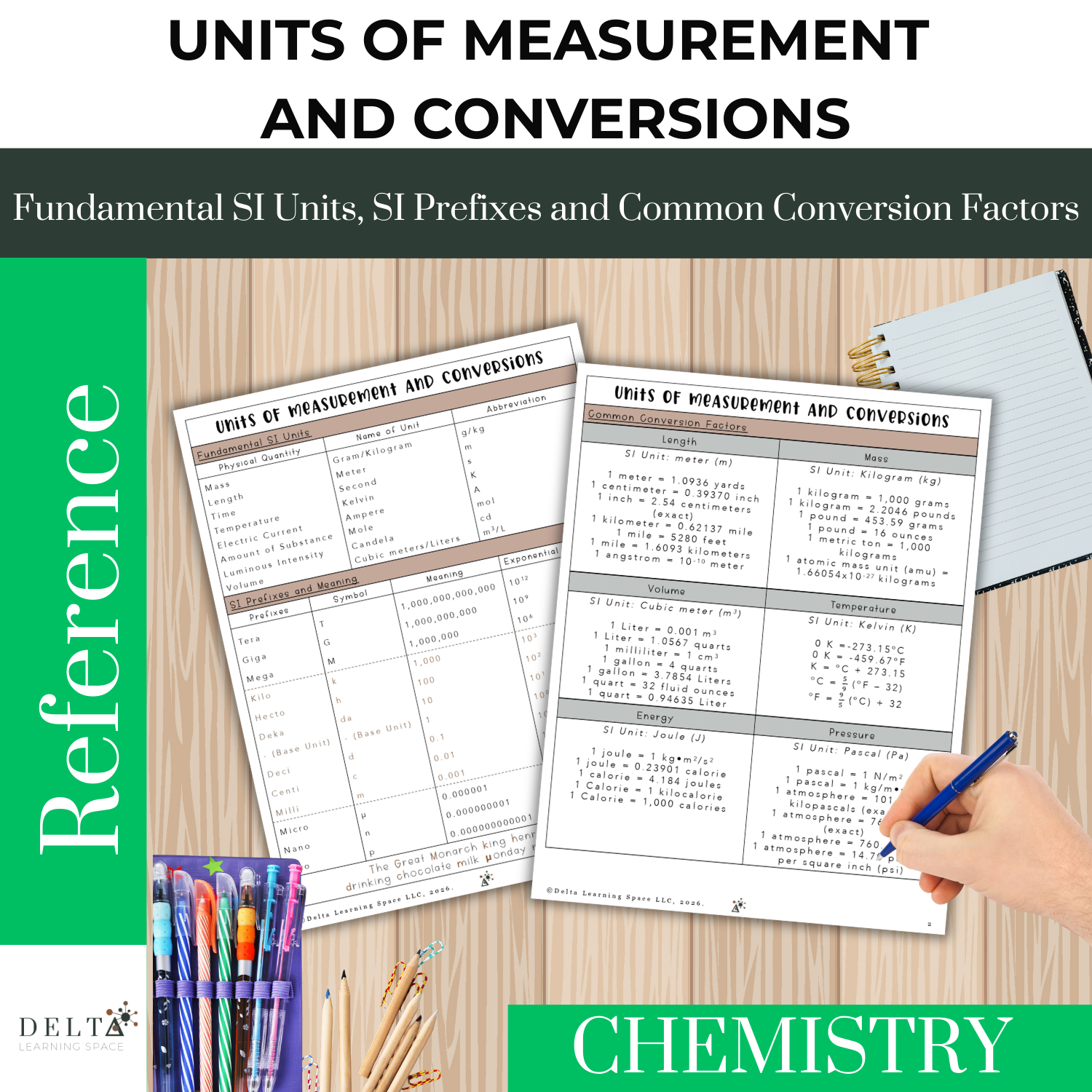
Download a Unit of Measurement and Conversion Reference and Practice Problems by signing up for free!
SI Base Units
Some fundamental SI units are listed below.
| Physical Quantity | Name of Unit | Abbreviation |
|---|---|---|
| Mass | kilogram | kg |
| Length | meter | m |
| Time | second | s |
| Temperature | kelvin | K |
| Electric Current | ampere | A |
| Amount of Substance | mole | mol |
| Luminous Intensity | candela | cd |
| Volume | cubic meter | m3 |
Mass
Mass is the amount of matter in an object. Mass is different from weight, because it includes the effect of gravity on an object. On Earth, mass and weight are often treated as equivalent in everyday contexts, but scientifically, they are not the same.
The SI base unit for mass is the kilogram (kg). In many situations, especially in chemistry, grams (g) are more convenient. Always refer to the context or formula to determine which unit is appropriate.
Length
Length is the measured distance of an object. It is a one-dimensional quantity, meaning it is measured in only one direction. The SI base unit for length is the meter (m).
Time
Time measures duration or how long an event lasts. The SI base unit for time is the second (s). Minutes and hours are also commonly used, depending on the context.
Temperature
Temperature is a measure of the average kinetic energy of particles in a system. In everyday language, temperature describes how hot or cold something feels.
The SI base unit for temperature is the kelvin (K). In the United States, degrees Fahrenheit (°F) are commonly used, while degrees Celsius (°C) are often used in scientific contexts. When working with formulas, it is important to use the correct temperature unit required by the equation.
Electric Current
Electric current measures the rate of flow of electric charge. The SI base unit for electric current is the ampere (A), often shortened to amp.
Amount of Substance
The amount of substance measures the number of specified particles, such as atoms, molecules, ions, or electrons. The SI base unit is the mole (mol).
One mole contains exactly 6.02214076 × 10²³ particles, a value known as Avogadro’s number.
Luminous Intensity
Luminous intensity measures visible light emitted from a source as perceived by the human eye. It does not account for all electromagnetic radiation; it only accounts for visible light. The SI base unit is the candela (cd).
Volume
Volume measures the three-dimensional space occupied by matter. The SI unit for volume is the cubic meter (m³). In practice, volume is often measured in liters (L), especially in chemistry. Always check which unit is required when using formulas.
SI Prefixes
While SI base units are standard, they are not always the most practical for every measurement. SI prefixes are used to adjust units to a more convenient magnitude.
For example, while the meter is the base unit of length, it would be impractical to measure the length of an ant in meters. A smaller unit, such as millimeters, is more appropriate.
SI prefixes are placed before the base unit to indicate magnitude. The only exception is the kilogram, which already includes a prefix. When converting mass units, prefixes are applied to the gram.
Below are common SI prefixes used in introductory science courses.
| Prefix | Symbol | Meaning | Exponential Notation |
|---|---|---|---|
| Tera | T | 1,000,000,000,000 | 1012 |
| Giga | G | 1,000,000,000 | 109 |
| Mega | M | 1,000,000 | 106 |
| Kilo | k | 1,000 | 103 |
| Hecto | h | 100 | 102 |
| Deka | da | 10 | 101 |
| Base Unit | — | 1 | 100 |
| Deci | d | 0.1 | 10-1 |
| Centi | c | 0.01 | 10-2 |
| Milli | m | 0.001 | 10-3 |
| Micro | µ | 0.000001 | 10-6 |
| Nano | n | 0.000000001 | 10-9 |
| Pico | p | 0.000000000001 | 10-12 |
Using SI Prefixes
SI prefixes allow scientists to express measurements at appropriate scales.
For example, to measure the length of an ant, millimeters (mm) are more practical than meters.
Prefix + unit: milli + meter = millimeter
Symbol: m (milli) + m (meter) = mm
One millimeter equals 0.001 meters, or 10⁻³ meters.
The “meaning” and “exponential notation” columns are especially useful for creating conversion factors, also called unit equalities.
Conversion Factors
A conversion factor is a ratio that expresses the relationship between two units. Because conversion factors represent equal quantities, they can be written in multiple ways.
Examples:
1 mm = 0.001 m (10⁻³ m)
1 m = 1,000 mm (10³ mm)
1 km = 1,000 m (10³ m)
1 m = 0.001 km (10⁻³ km)
Conversion factors are the foundation of dimensional analysis.
Dimensional Analysis: Setting Up Conversions
Dimensional analysis is a problem-solving strategy that uses units to guide calculations. Units behave like algebraic variables: they can be multiplied, divided, and canceled.
If the same unit appears in both the numerator and denominator, it cancels out.
Dimensional Analysis Setup Rules
Write the given value and unit
Multiply by a conversion factor written as a fraction
Place the unit you want to eliminate in the denominator
Check that unwanted units cancel
Perform the math and write the final unit
If your units cancel correctly, your setup is correct, even before doing the math.
Example 1: Converting Kilograms to Grams
Convert 30 kg to grams
Conversion factor:
1 kg = 1,000 g
Set up the problem so kilograms cancel:
30 kg × (1,000 g / 1 kg)
The kilograms cancel, leaving grams:
30 kg × (1,000 g / 1 kg) = 30,000 g
Example 2: Multi-Step Conversion
Convert 250 cm to km
Step 1: Convert centimeters to meters
250 cm × (1 m / 100 cm) = 0.25 m
Step 2: Convert meters to kilometers
0.25 m x (1 km / 1,000 m) = 0.0025 km
Steps 1 and 2 can be combined to one dimensional analysis formula
250 cm × (1 m / 100 cm) × (1 km / 1,000 m)
Both centimeters and meters cancel, leaving kilometers:
= 0.0025 km
Final Thoughts
Dimensional analysis is not about memorizing steps; it is about using units to think through a problem. When set up correctly, the units guide the solution and reduce errors.
Mastering SI units and conversions is a foundational skill that supports success in chemistry, physics, and other scientific disciplines.